Remember to Forget: Gated Adaptive Positional Encoding
Abstract
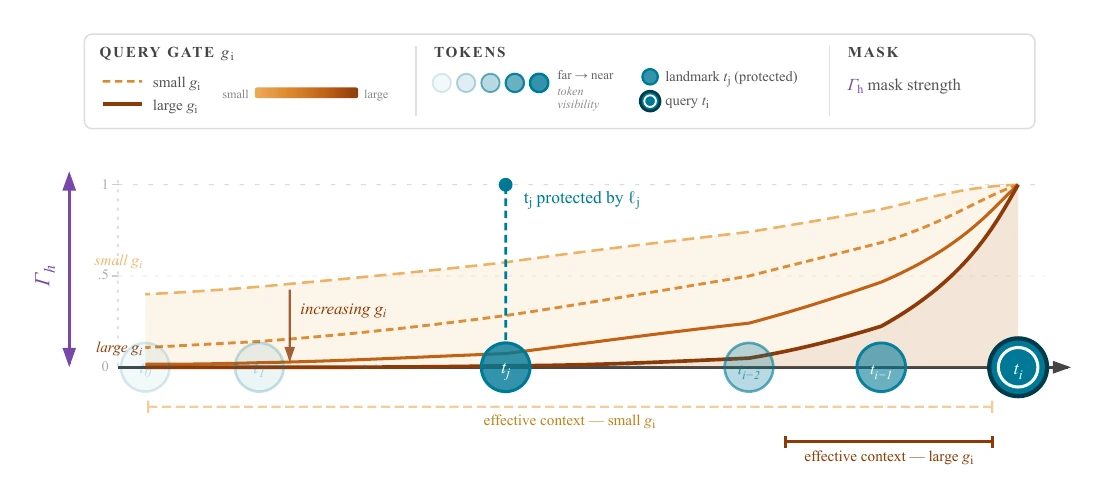
Rotary Positional Encoding (RoPE) is widely used in modern large language models. However, when sequences are extended beyond the range seen during training, rotary phases can enter out-of-distribution regimes, leading to spurious long-range alignments, diffuse attention, and degraded retrieval. Existing remedies only partially address these failures, as they often trade local positional resolution for long-context stability. We propose GAPE (Gated Adaptive Positional Encoding), a drop-in augmentation for positional encodings that introduces a content-aware bias directly into the attention logits while preserving the rotary geometry. GAPE decouples distance-based suppression from token importance through a query-dependent gate that contracts irrelevant context and a key-dependent gate that preserves salient distant tokens. We show that weakly protected distant context is exponentially attenuated as a function of the query gate, while selected keys can remain accessible through landmark protection. We further show that GAPE can be implemented within standard scaled dot-product attention. Empirically, GAPE improves long-context robustness across controlled retrieval and language-modeling experiments, extrapolating up to 8× the training length. We further retrofit GAPE into a pretrained 7B model, maintaining performance on standard benchmarks and improving performance at the longest evaluated context. These results support adaptive context suppression as a complement to positional representation for long-context generalization.